
deepening embodied relational SKILLS
Tuesdays // beginning in February 2027
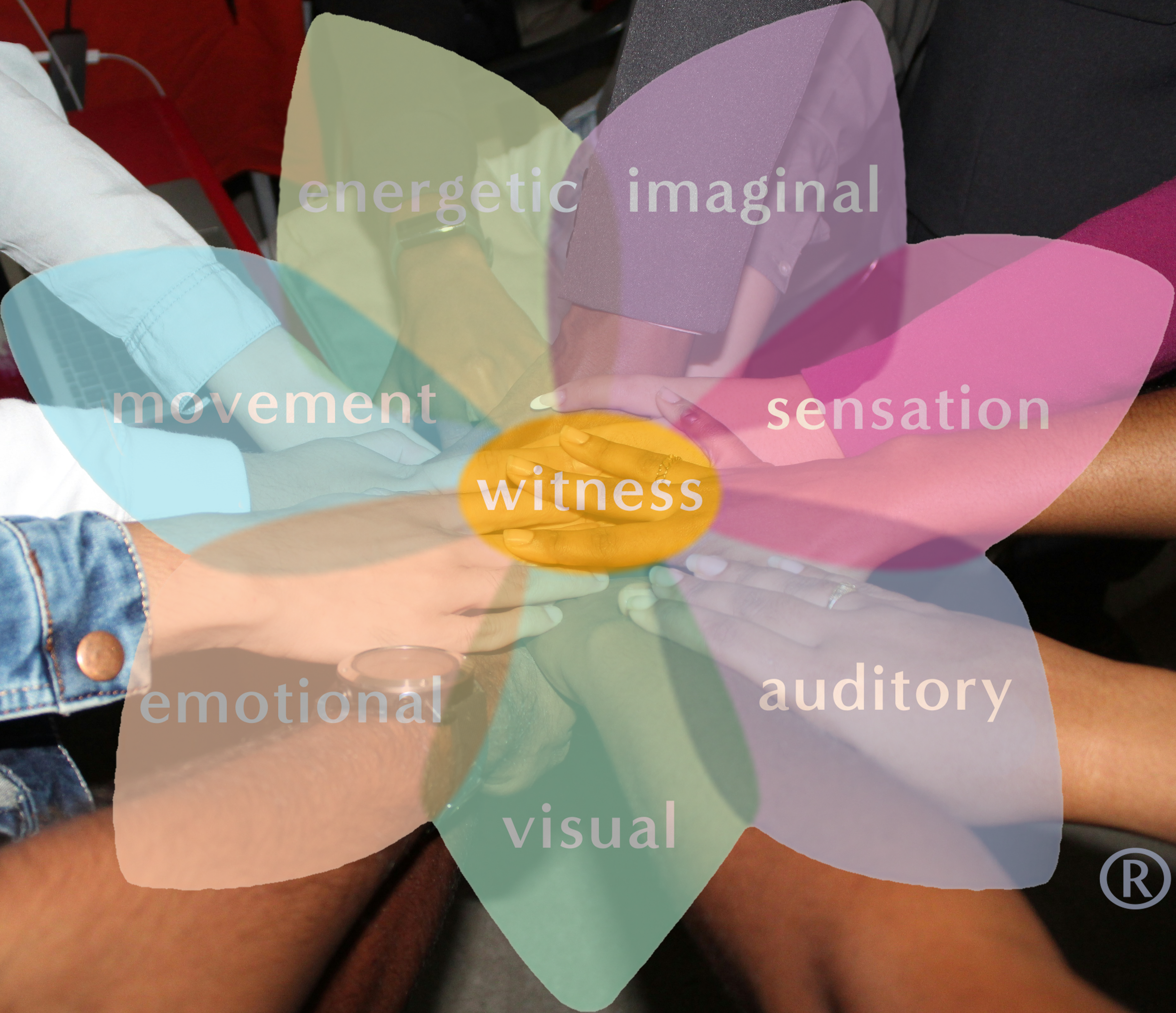
The Seven Channels Process Training Group focuses on giving, receiving, and internalizing the transformative gifts of the secure base we aspire to create as therapists. Our emphasis will be on integrating and deepening the therapists’ sense of self. We will explore alternate pathways that can arise of countertransference reactivity with certain psychotherapy clients, especially with couples.
Participants will practice whole-body, moment-to-moment somatic tracking and while speaking in explicit I-statements about their internal experience. This process fosters an atmosphere of subtle discernment and invites surprising moments of selective perception, bottom-up awareness, receptive presence, and mindful expression.
This small-group series of six builds on self-at-best skill development, cultivating heart-to-heart compassion, inner reflection, and acknowledgment of both self and other. We will also explore principles of affective neuroscience and the transformation of attachment patterns through subtle teaching moments integrated into the experiential work of the group sessions.
-
Tuesdays: 2/16/27, 3/16/27, 4/20/27, 5/18/27, 6/15/27, 9/21/27, 10/19/27, and 11/16/27
-
Registration is not yet open. Please come back soon.
-
Identify at least four of the Seven Channels of Experience and describe their relevance to clinical assessment and intervention.
Explain why identifying internal states through multiple perceptual channels—beyond emotion alone—supports accurate case conceptualization.
Describe how attunement to the energetic channel can enhance therapist self-regulation and therapeutic presence with clients.
Identify indicators of increased dorsal vagal response and explain how these indicators may impact a client’s capacity for engagement and responsiveness to relational cues.
Apply awareness of subtle emotional cues in couple members to facilitate therapeutic dialogue in couple or group therapy.
Describe at least one way that tracking somatic sensations of tension or relaxation can be used to support co-regulation with clients in treatment.
Demonstrate the use of present-tense awareness and language when guiding clients through healing portrayals or experiential interventions.
Differentiate between interventions based primarily on projection/judgment and those informed by moment-to-moment body-based awareness in clinical practice.
Identify early signs of therapist reactivity and describe strategies for self-regulation in session to maintain therapeutic effectiveness.
Identify one primary channel of experience commonly used as an attunement anchor (“North Star”) when tracking client states in session.
Identify at least one channel of experience that may present as less accessible or under-developed and describe how this may impact therapeutic attunement.
Demonstrate a structured body-scan intervention to support client access to internal awareness during therapy.
Explain how use of the visual channel can assist in identifying early indicators of escalating tension between couple members.
Provide examples of auditory-channel attunement strategies that support emotional regulation in individual therapy sessions.
Describe how observation of movement and gesture can be used to assess relational dynamics in individual, couple, or family therapy.
Apply the imaginal channel to help clients articulate relational needs and longings within the therapeutic process.
-
All times are in Pacific Time.
10:00-10:20am: Orientation and opening five-minute Channels of Experience meditation
10:20-10:45am: Check-in and discussion of each participant’s response to the meditation and any breakthroughs of awareness that they want to share are invited. Questions about the Seven Channels of Experience or mindful and selective access to them are part of the process.
10:45 to 11:45: Facilitated interaction that demonstrates grounded alternatives of affective regulation and moment-to-moment tracking as alternatives to potential reflexive reactivity, and negative judgment, while practicing selective perception, reception and expression using I- language and the seven channels.
11:45-12:00pm: Metaprocessing and closing
-
Participants must complete all sessions to be awarded CE. Cameras on Zoom must be left on, with only brief exceptions. An evaluation will be required prior to CE being awarded. Attendance will be taken and documented each session. No specific assignments are required, other than reading the course materials sent out before we meet a session. Any questions can be addressed to davidmarsphd@gmail.com. To attend this live, interactive course you must have access to a working computer, a room with sufficient privacy to protect the confidentiality of couple members whose clinical work is shown and internet connectivity sufficient to maintain a stable connection to Zoom.
At the end of the course, CE can be applied for via this link
The cost for 16 Continuing Education (CE) credits is $40. An email will be sent to all participants who complete the course from Credits Education.
Credits.Education, #1032827, is approved by the California Association of Marriage and Family Therapists to sponsor continuing education for LMFTs, LCSWs, LPCCs, and LEPs. Credits.Education maintains responsibility for this program/course and its content. Course meets the qualifications for 16 hours of continuing education credits for LMFTs, LCSWs, LPCCs, and LEPs as required by the California Board of Behavioral Sciences.
IT IS THE RESPONSIBILITY OF PARTICIPANTS TO CHECK WITH YOUR LOCAL BOARD TO CONFIRM IF CAMFT CE QUALIFIES FOR YOUR LICENSE.
-
This course is designed for intermediate to advanced learners.
Our target audience is Psychiatrists, Psychologists, Psychotherapists, MFT's, Social Workers, Registered Counselors, Pastoral Counselors.
Cancellation policy: You may end your enrollment at any time and receive a refund for the remaining sessions of the course.
Questions or concerns may be communicated by email to davidmarsphd@gmail.com.
If you have a need for ADA accommodation, please contact davidmarsphd@gmail.com
David Mars, PhD, the presenter for this course, holds a PhD in Psychology, is licensed as an MFT, and has taught Transformative Couples Therapy® and Seven Channels Process Training Groups to psychotherapists since 2008. He is the developer of the methods and taught them as a faculty member of the AEDP Institute for eleven years. He is the director of the Transformative Couples Therapy® Institute has been treating couples in private practice for over forty years. Click here for a more complete bio.
There are no conflicts of interest or external commercial support related to this course or any course offered by the Transformative Couples Therapy® Institute.